
Hey, starting out with electricity can feel overwhelming, but it’s really just a few core ideas that make everything click. I’ve taught this stuff to friends who knew nothing, and once they got the basics, they were fixing their own lamps. Let’s keep it simple and fun.
Where It All Starts: Atoms and Charges
Everything around us is made of tiny building blocks called atoms. In the middle, you’ve got protons (positive charge) and neutrons (neutral). Zoom out to the edges, and there are electrons (negative charge) buzzing around.
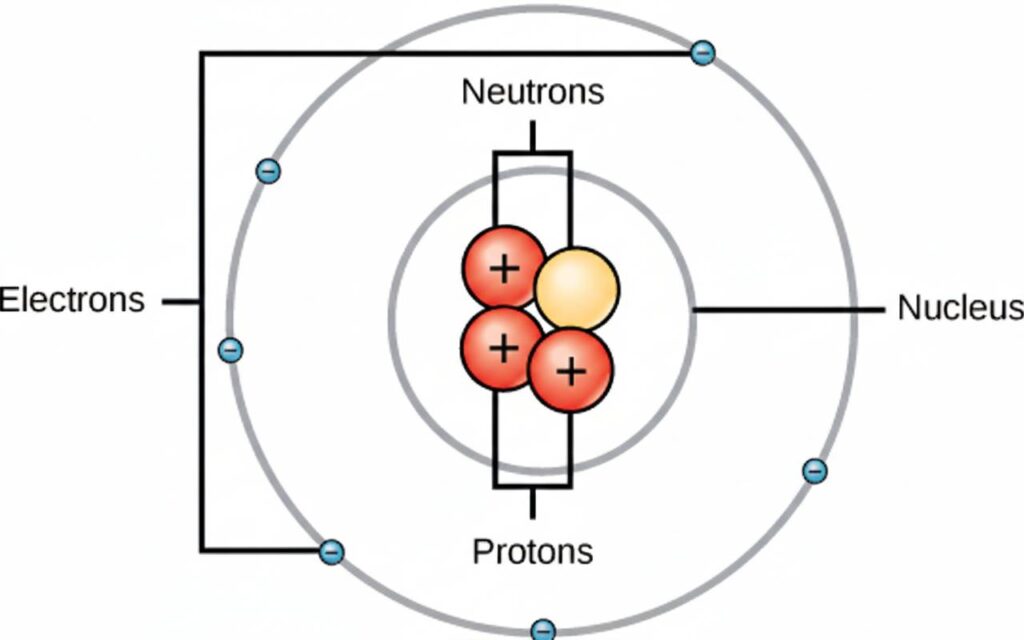
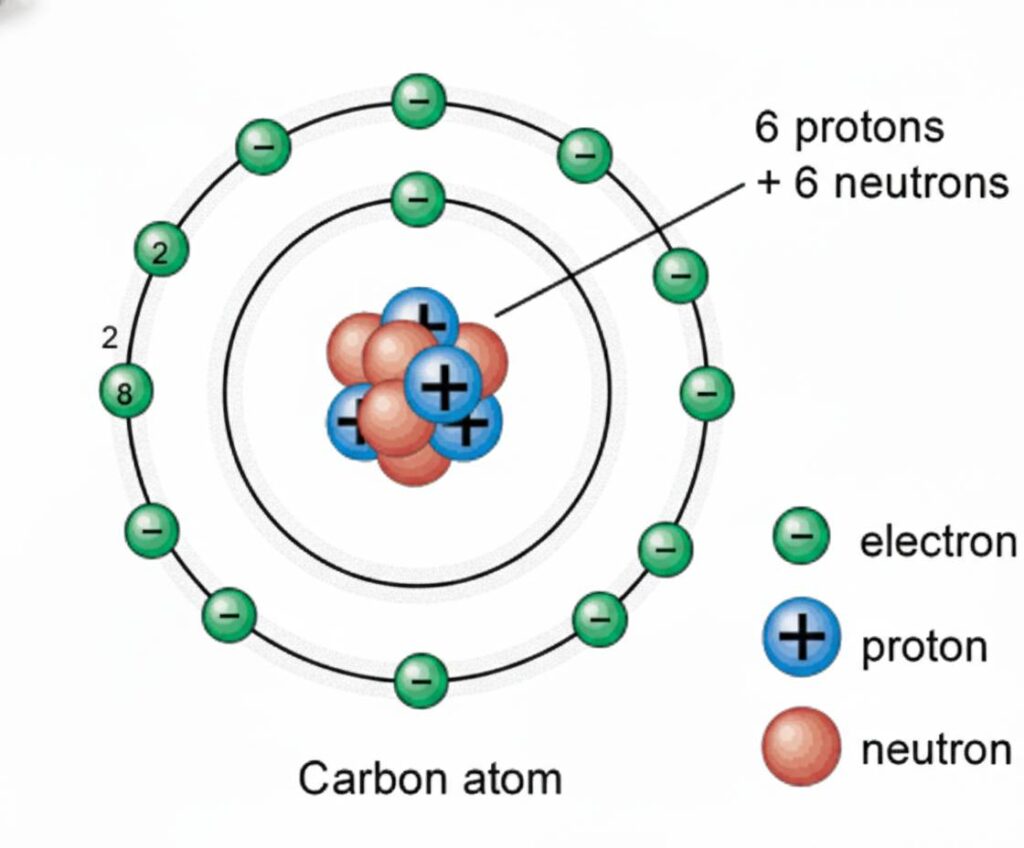
Electrons can jump from one atom to another. When they do, you get a charge imbalance – that’s static electricity, like the shock from a doorknob. In wires, we control that movement to make useful power.
The Big Three: Voltage, Current, and Resistance
These are the fundamentals. The water analogy helps a ton here.
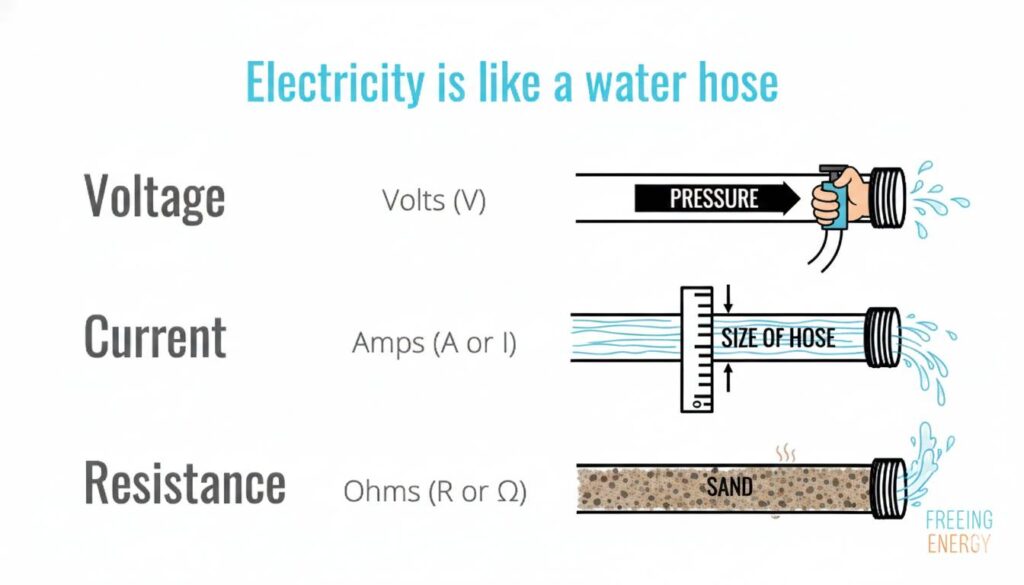
- Voltage (volts, V): The “pressure” pushing electrons. Like water pressure in a tank.
- Current (amps, I): The flow – how many electrons move past a point per second. Like gallons per minute.
- Resistance (ohms, Ω): Opposition to flow. Narrow pipes or bad materials slow it down.
No pressure? No flow. Too much resistance? Weak flow.
Circuits: The Path Electricity Takes
Electricity needs a complete loop to flow – that’s a circuit. Break the loop, and it stops.
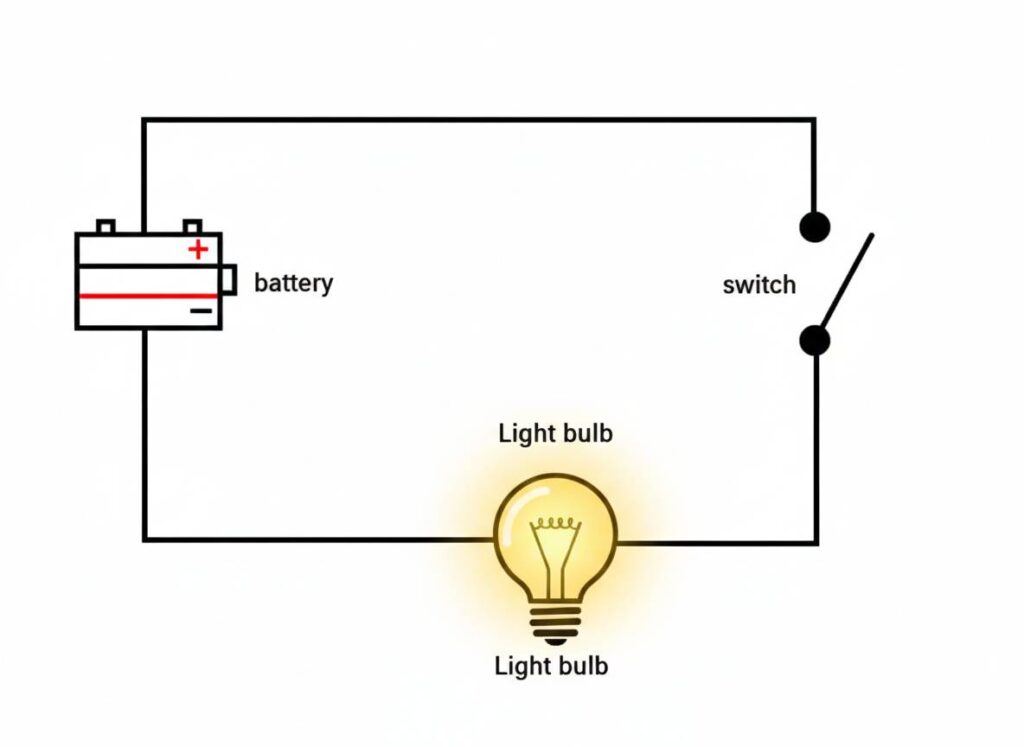
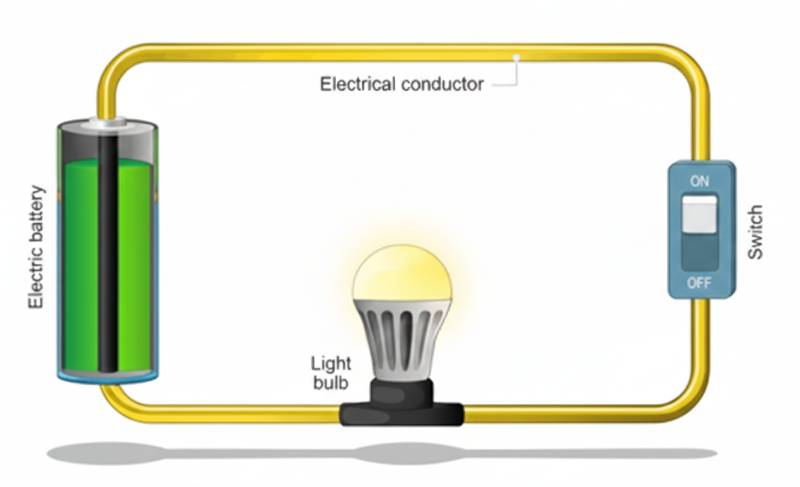
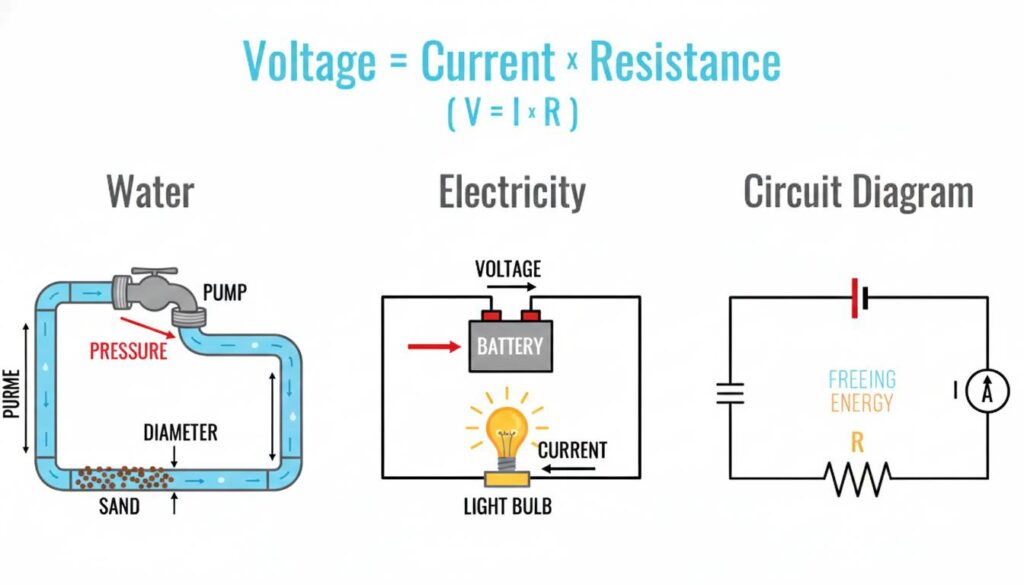
Basic one: Battery (provides voltage), wires, switch, and a bulb. Close the switch – current flows, bulb lights. Open it – done.
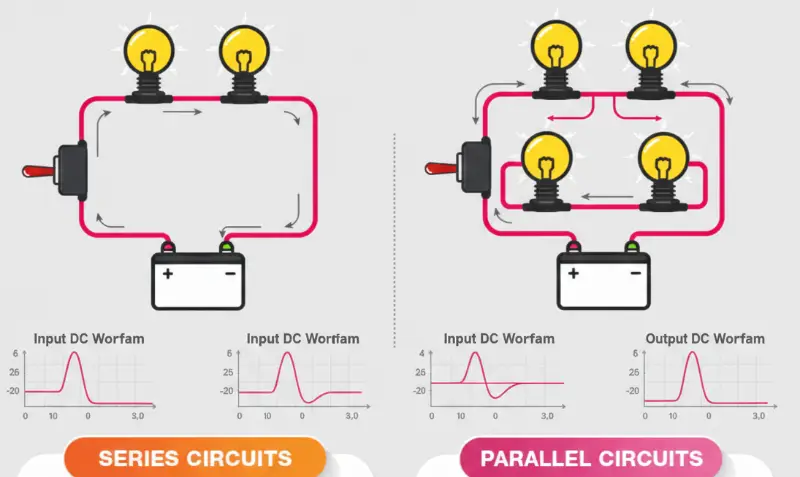
There are series circuits (one path, like old Christmas lights – one out, all out) and parallel (multiple paths, like home wiring – one bulb burns, others stay on).
Ohm’s Law: The Golden Rule
This ties the big three together: V = I × R.
Super handy triangle for remembering.
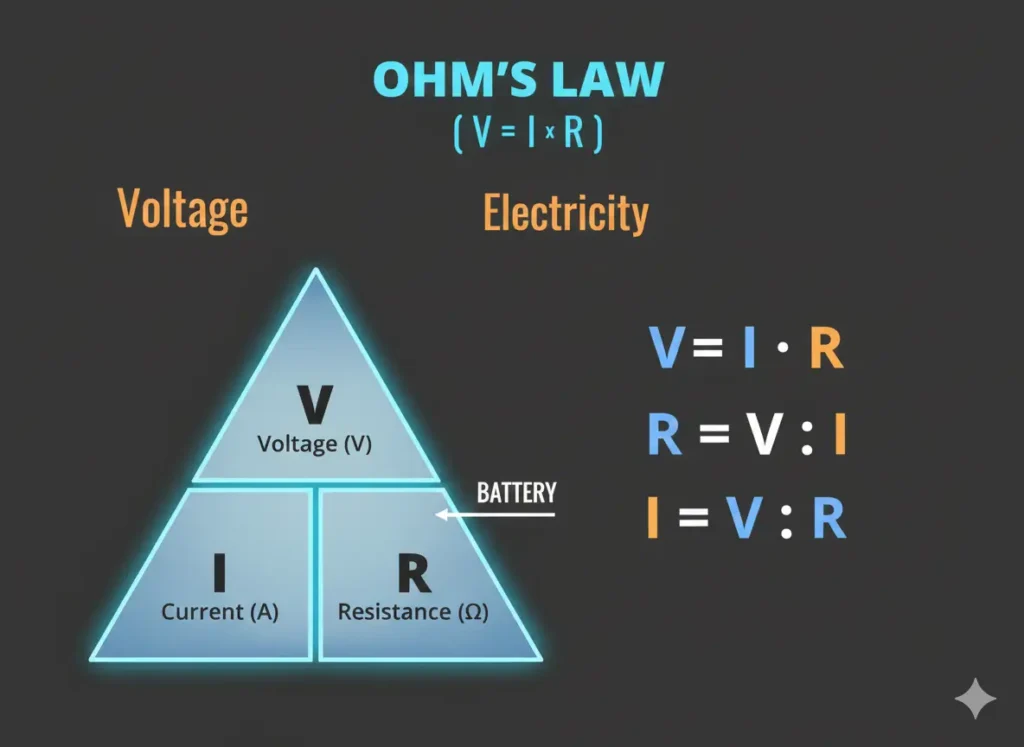
Example: 9V battery, 3Ω resistor. Current = 9 / 3 = 3 amps.
Power (watts) is P = V × I – tells you energy used.
AC vs DC: Two Types of Current
- DC (Direct Current): Flows one way. Batteries, solar panels. Steady.
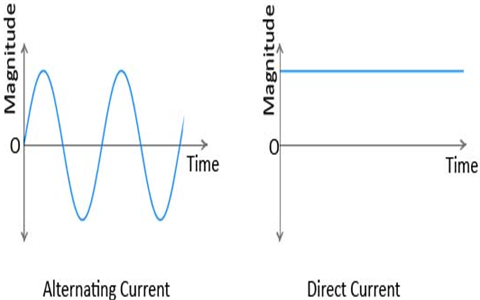
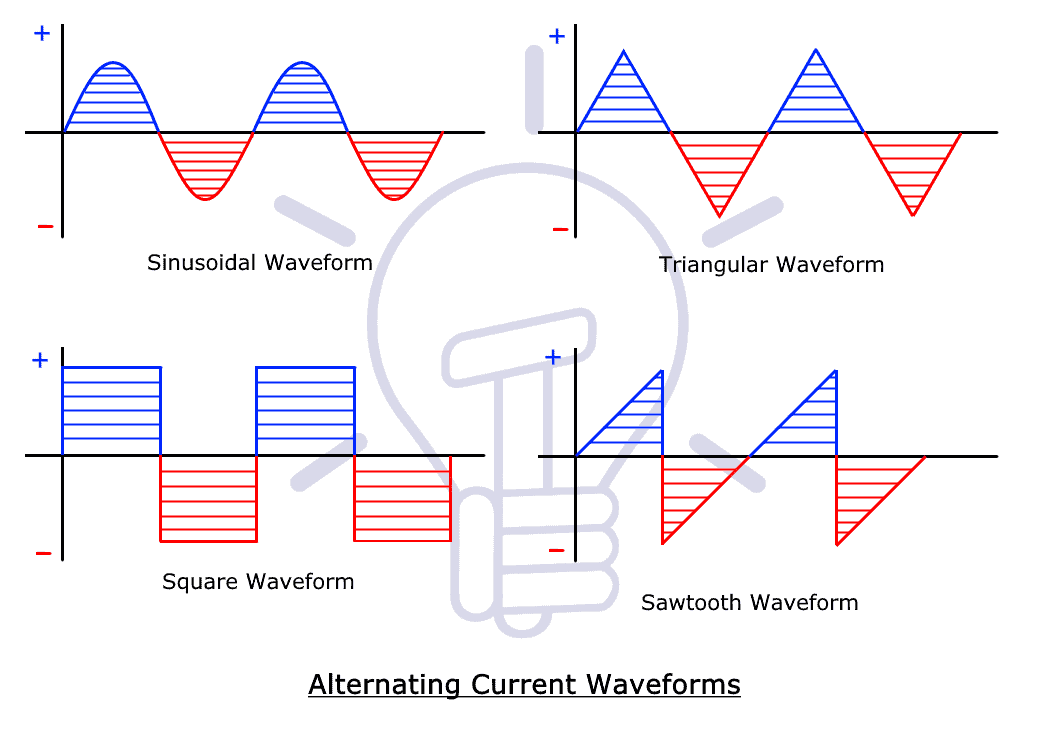
- AC (Alternating Current): Flips direction 50-60 times a second. Wall outlets – easier to send long distances.
Most gadgets convert AC to DC inside.
Conductors, Insulators, and Safety Basics
Good conductors (copper, aluminum) let current flow easy. Insulators (rubber, plastic) block it – that’s why wires have coating.
Grounding gives stray current a safe path. Breakers trip on overloads.
Practical Tips to Get Started
Buy a cheap multimeter – measure voltage and continuity. Start with a battery, wires, and LED. Add a resistor so you don’t burn it out.
Never poke around live outlets. Dry hands, no water near electricity.
Label your home breaker box – saves time in outages.
FAQs for Beginners
What’s the safest way to experiment? Low voltage only – 9V batteries or less. Kits are great.
Why do lights flicker sometimes? Voltage dips or loose connections.
How much current is dangerous? Even 0.1 amps through your body can hurt; voltage gets it in.
What’s a short circuit? Low resistance path – huge current, sparks, trips breaker.
Can I mix AC and DC? Nope – devices are built for one. Wrong one damages stuff.