
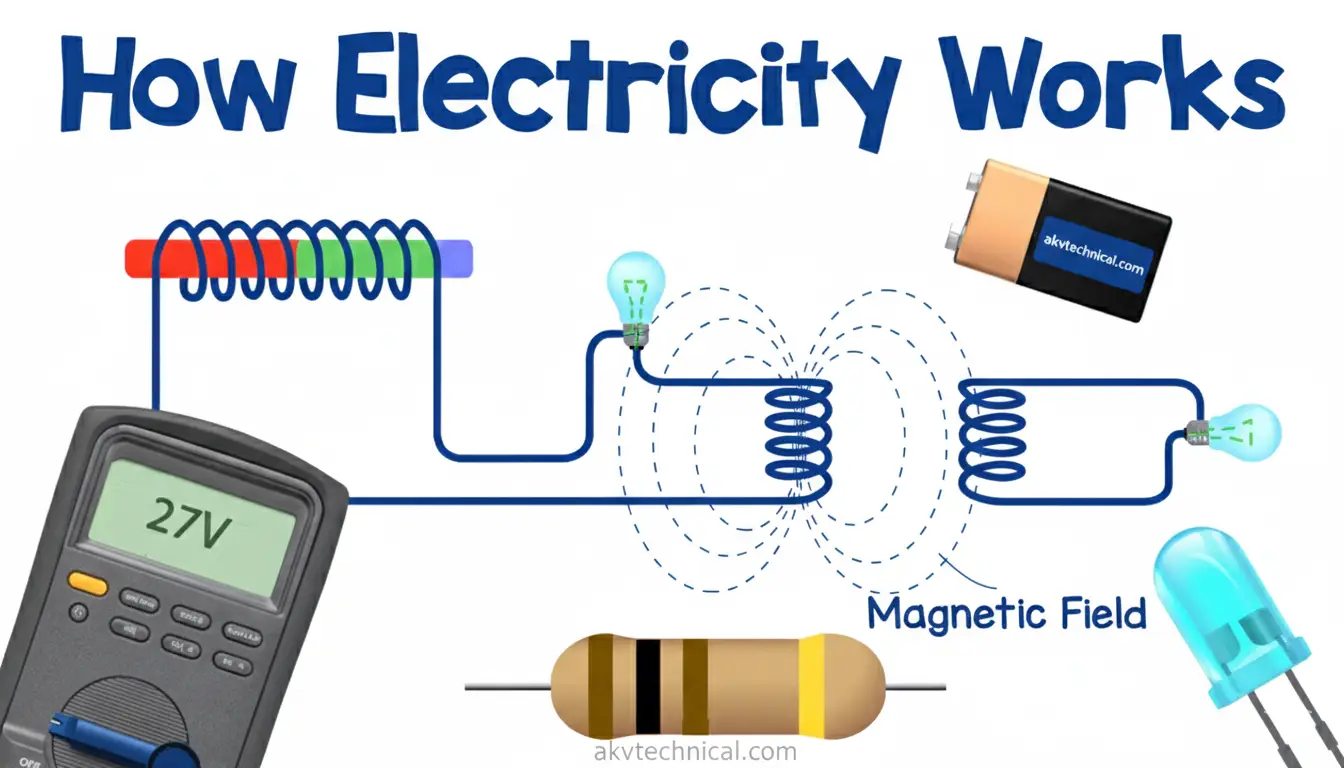
How Electricity Works You know that buzz when you plug something in and it just comes to life? Electricity powers all that, but it’s not some mystery. I’ve spent time wiring up projects and fixing outlets, and breaking it down step by step makes it click.
The Basics in Plain Words
At its core, electricity is about tiny charged particles called electrons moving around. Atoms have protons (positive) and electrons (negative), and when electrons get pushed from one place to another, that’s the flow we call current. Materials like metals let them move easily; others block them.
It’s like a chain reaction – create a path, add some force, and electrons start flowing to do work, whether it’s lighting a bulb or running a motor.
Step-by-Step Breakdown
Here’s how it all happens, from start to finish. I’ll keep it straightforward, like walking through a workshop demo.
- Electrons and charges get set up. Everything begins with atoms. Rub two things together, and electrons jump, creating static. In real electricity, we need a steady supply – think batteries using chemicals to separate charges or generators spinning magnets to induce flow.
- Voltage provides the push. This “pressure” difference makes electrons want to move from high to low potential. Power plants create massive voltage to send electricity far.
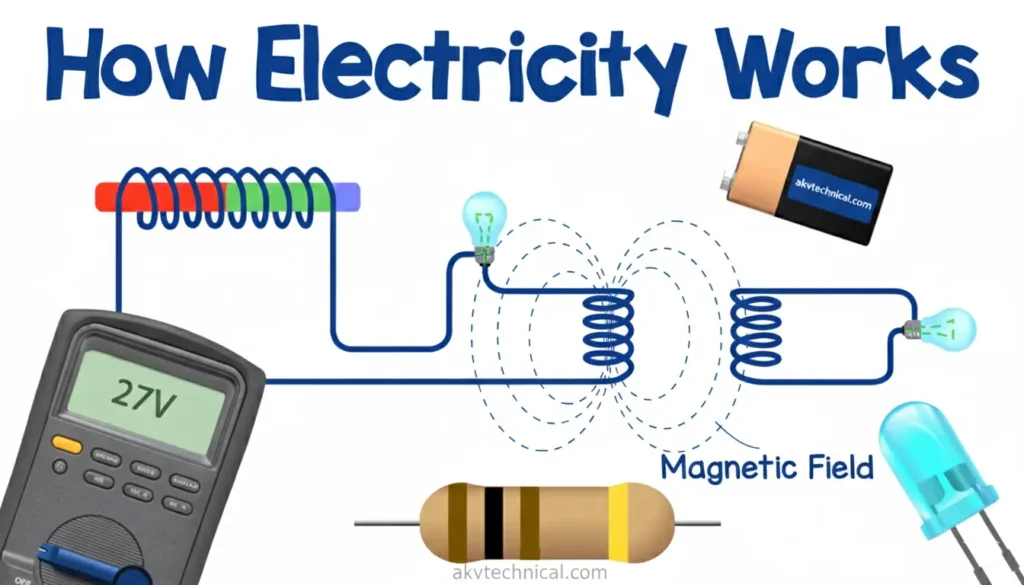
How Electricity Works – The Engineering Mindset
- Current starts flowing through conductors. Once there’s a closed loop (circuit), electrons flow as current. Wires carry it; insulators like plastic keep it contained.
- Resistance comes into play. Not all paths are easy – resistance slows the flow, turning some energy into heat or light. Thinner wires or poor materials increase it.
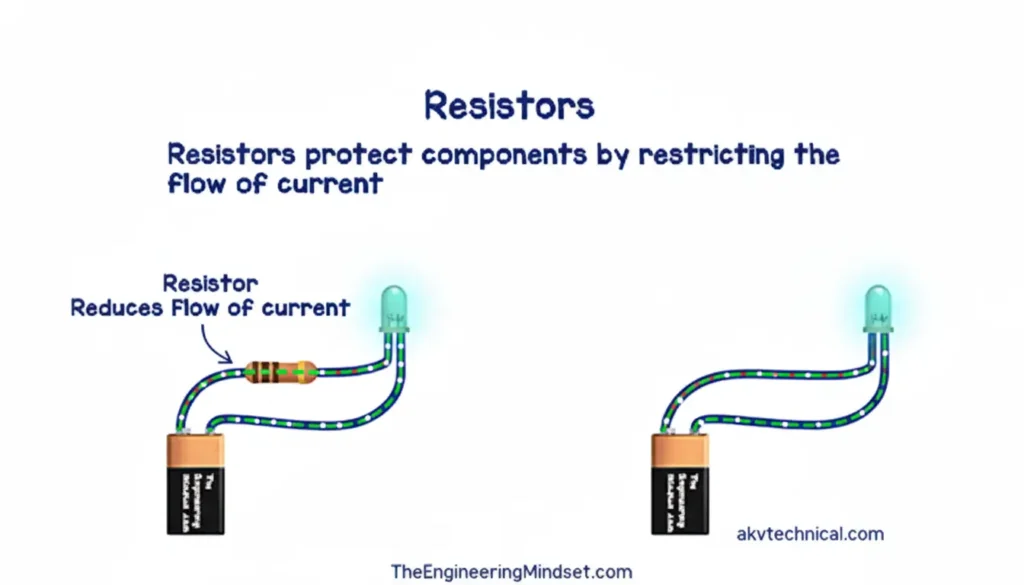
How Electricity Works – The Engineering Mindset
- Transformation and distribution. High voltage travels long distances via grids, then transformers step it down for safe home use.

How Electricity Works – The Engineering Mindset
- Usage in devices. At your outlet, the current powers appliances – it flows through, does work (like heating a coil), and completes the circuit back.
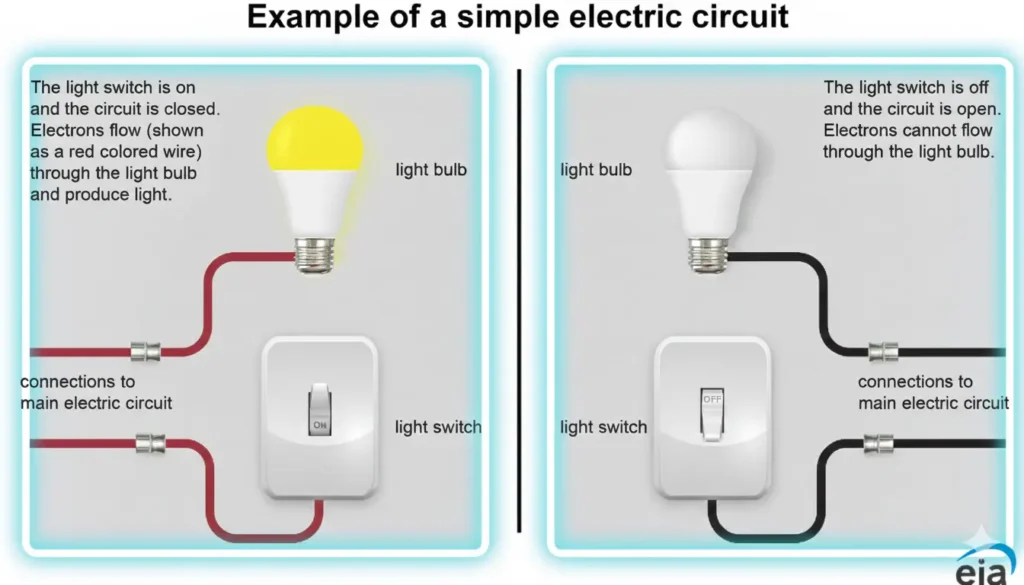
Batteries, circuits, and transformers – U.S. Energy Information …
- Safety mechanisms kick in. Breakers or fuses stop overloads if current spikes, preventing fires.
Formulas That Tie It Together
Ohm’s Law is key: V = I × R. Voltage equals current times resistance. It’s helped me calculate wire sizes forever.
Power adds in with P = V × I – tells you watts used. For a 120V outlet with 10A current, that’s 1200W, enough for a microwave.

Electricity How It Works: Voltage & Ohm’s Law
Real-Life Examples and Slip-Ups
Flip on a lamp: Battery or outlet provides voltage, current flows through the bulb’s filament (high resistance), heats it to glow, and loops back.
Common mistake? Thinking electricity flows super fast – actually, electrons drift slowly, but the energy wave zips along near light speed. I’ve shorted circuits by forgetting to unplug – sparks fly quick.
Another: Overlooking ground wires. They safely redirect faults, saving you from shocks.
Tips from Hands-On Experience
Start small – build a circuit with a battery, wire, and bulb to see the flow. Use a multimeter to measure voltage drops.
For home stuff, check amp ratings on extensions; don’t daisy-chain them. LEDs save energy because lower current for same light.
Always kill power at the breaker before work. I’ve gotten zapped ignoring that.
FAQs on How Electricity Works
What’s the first step in generating electricity? Usually spinning turbines in power plants to move magnets and induce current.
Why does electricity need a closed circuit? Electrons have to loop back; open it, and flow stops, like a broken pipe.
How’s AC different from DC step by step? DC flows one way (batteries); AC flips direction (outlets) for efficient long-distance travel.
Can I feel the steps happening? Not really – it’s invisible, but meters show voltage, current changes.
What’s a quick way to test if it’s working? Use a tester on outlets; lights up if voltage is there.